
Grab bag
What to Put in a Grab Bag
6 min read · Last reviewed 20 September 2026
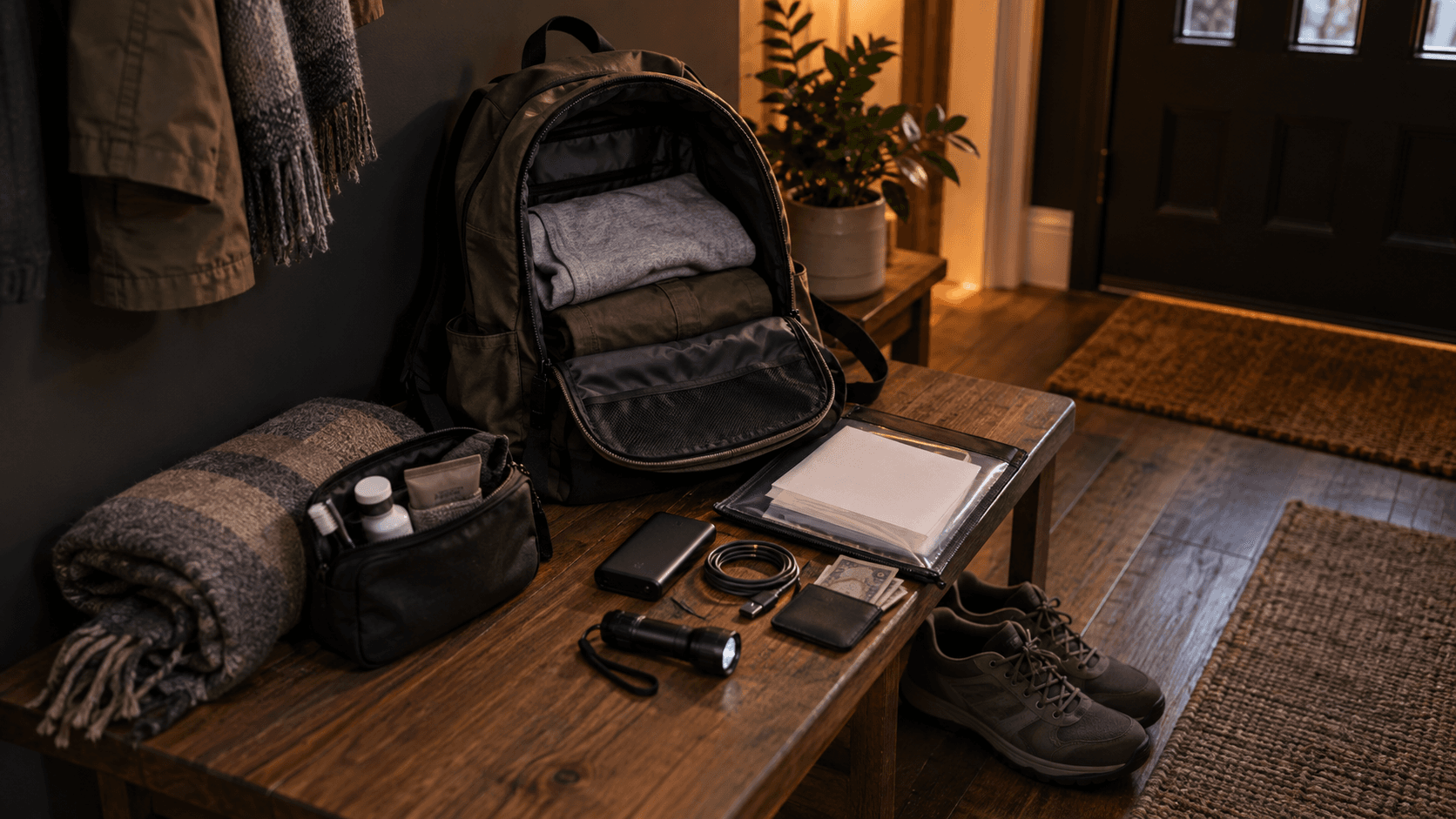
A grab bag holds what you would want if you had to leave home at short notice: copies of important documents, a written list of medication, phone charging, a change of clothes, basic toiletries, some cash, and a couple of days of essentials for anyone who cannot fetch their own. Keep it light enough to carry.
What a grab bag is actually for
A grab bag is not a survival rucksack, and it is not for living off. It is for the few hours between leaving your home unexpectedly and arriving somewhere else (a relative's house, a hotel, or a rest centre) with the things that would otherwise be difficult or impossible to replace.
The realistic reasons for leaving in a hurry are ordinary ones: a flood warning, a gas leak, a burst main, or a structural problem in the building. In most of these the emergency services or the council are involved and somewhere to go is organised. What is not organised is your paperwork, your medication or your children's shoes.
One exception matters more than anything else on this page. If you are escaping a fire, take nothing at all. Official guidance is explicit about this: get out, stay out, call 999. A grab bag is for a planned or warned evacuation, never for a fire.
Most households will never use one. It is worth twenty minutes and a spare rucksack anyway, particularly if you can check your address and find it is in a flood risk area.
Start with what you cannot replace
If you pack nothing else, pack the paperwork. Everything else in the bag can be bought again on the way; a prescription list and an insurance policy number cannot be reconstructed from memory at eleven at night.
| Category | What to include | Why |
|---|---|---|
| Documents | Copies of ID, insurance, tenancy or mortgage details, bank details | Paper works with no power and no signal |
| Household plan | The government's printable household emergency plan, filled in | Puts contacts, meeting point and medication on one sheet |
| Medication | A written list of who takes what and the dose, plus the pharmacy | Lets a pharmacist or clinician help quickly |
| Contacts | A printed sheet of family, neighbours, GP, insurer, utilities | Nobody remembers numbers, and phones die |
| Power | Charged power bank and the right cables | Your phone is your map, your bank and your address book |
| Money | A small amount of cash in small notes | Card machines and cash points depend on power |
| Comfort | A change of clothes, toiletries, a torch, a blanket | Turns an unpleasant night into a manageable one |
Keep it liftable
The most common mistake is packing a bag nobody can carry. A grab bag that needs two hands and full attention is a problem if you are also carrying a child, managing a pet or helping someone down a staircase.
A 25 to 35 litre rucksack is about right for an adult: large enough for a change of clothes and the essentials, small enough that it stays honest. Two smaller bags spread between two adults beat one heavy one. Children from about five can carry their own very small bag with a toy, a jumper and a drink, which also gives them something to be in charge of.
- One bag per adult, not one enormous bag for the household
- Rucksack rather than holdall, so your hands stay free
- Pack it, then carry it up and down the stairs once. That is the real test
- Keep shoes and a coat near it, because leaving in slippers is more common than you would think
Babies, children and pets
A baby changes the bag more than anything else, because the items are the hardest to improvise at short notice: nappies, wipes, a change of clothes, a blanket, and whatever you normally use for feeding. Ready-to-feed formula avoids needing clean water and sterilising equipment.
For pets, a spare lead or harness, a collapsible bowl, a few days of the food they actually eat, waste bags, and their microchip and vet details. A carrier matters for cats: without one, taking the cat is often not possible.
For children of any age, a familiar toy does more good than almost anything else in the bag. If you can keep a duplicate of the favourite one permanently packed, do.
What to leave out
Grab bag lists on the internet tend to accumulate equipment. In a UK context, most of it is weight you will carry for years and never use.
You do not need camping equipment, water purification for a week, multiple knives or anything sold as tactical. You are going to a building with a roof, not into the hills. Every item that goes in should answer the question: in the first twenty-four hours after leaving my home, what would I use this for?
Where to keep it, and keeping it current
By the door you would actually leave through, or in the hall cupboard or under the stairs. A bag in the loft is not a grab bag. Everyone in the household should know where it is, including anyone who stays with you regularly.
Official guidance suggests keeping it with your other important documents (passports, birth certificates, insurance policies) so that everything you would want is in one place if you are asked to leave. It also suggests agreeing a meeting point in advance for situations where you cannot get home.
Check it twice a year. Tying it to the clocks changing works, and pairs with testing your smoke alarms. Replace anything borrowed, check the document copies are still current, update the medication list, and top up the power bank. The most common failure is not a missing item, it is a bag that has quietly been raided for batteries.
What this means for your kit
A grab bag and a home kit overlap less than people expect: the home kit is built around staying put comfortably, and the grab bag around leaving quickly with what matters. The builder treats them as separate lists, so you can put together whichever you need first.
Build a grab bag list
The builder produces a grab bag list scaled to your household, including what to add for a baby or pets, and shows you what you already have.
Build My Emergency KitCommon questions
- What is the difference between a grab bag and a home emergency kit?
- A home kit is for staying put (water, food, light, warmth) and can be bulky. A grab bag is for leaving quickly and holds documents, medication details, charging and a change of clothes. Most households benefit more from the home kit first.
- How heavy should a grab bag be?
- Light enough to carry up and down stairs while also managing a child or a pet. A 25 to 35 litre rucksack per adult is a sensible limit, and packing to fill the bag is not the goal.
- Do I need a grab bag if I am not in a flood risk area?
- It matters less, but fires and gas leaks happen anywhere. If you keep nothing else, keep copies of your documents and a written medication list somewhere you can pick up quickly.
- What documents should go in it?
- Copies rather than originals: ID, insurance details, tenancy or mortgage information, bank details, and a printed list of contact numbers. A waterproof wallet keeps them together and dry.
- How often should I check it?
- Twice a year is plenty. Doing it when the clocks change means it happens alongside testing your smoke alarms, and it takes about ten minutes.
Useful sources
- Check for flooding (GOV.UK)
- Get prepared for emergencies (GOV.UK Prepare)
- Prepare (GOV.UK)
My Emergency Kit is an independent service and is not affiliated with or endorsed by the UK Government or emergency services. Our suggestions are general information for UK households, not professional, medical or emergency advice. In an emergency call 999.
Keep reading
- What to do in a power cutThe first things to check, who to call, why the fridge should stay shut, and what to do if it goes on for hours.
- How much water should you store?A simple rule of thumb, what it comes to for your household, how to store it without losing a cupboard, and what to do under a boil notice.