
Power
What to Do in a Power Cut
6 min read · Last reviewed 20 September 2026
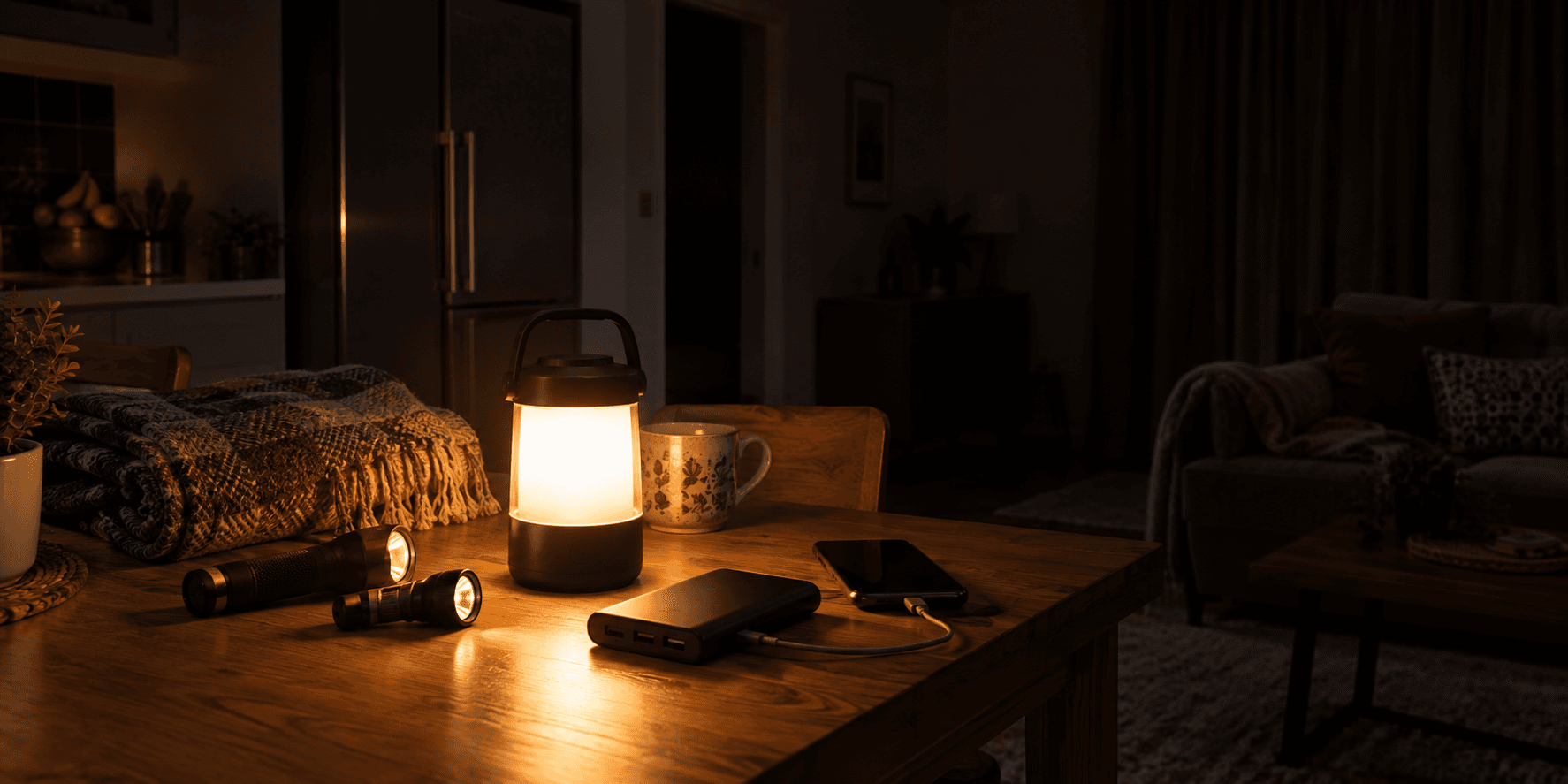
First check whether it is only your home: if your neighbours still have power, the problem is probably your own fuse box. In England, Scotland and Wales you can call 105 free to report a power cut. Then leave the fridge and freezer shut, use torches rather than candles, and charge phones early.
Check whether it is just you
Before you report anything, look out of the window. If the street lights and your neighbours' houses are dark, it is a network fault and someone is already working on it. If everyone else has power, the fault is almost certainly inside your home.
Two things account for most single-house outages. The first is a tripped switch in your consumer unit (the fuse box, usually in a hallway, cupboard or garage). A single appliance developing a fault will trip it, so switch everything off at the socket, reset the trip, then turn appliances back on one at a time until it goes again. The one that trips it is the one to stop using.
The second is a prepayment meter that has run out of credit, which is easy to miss in the dark. Most meters give some emergency credit, and topping up will restore the supply.
Report it, and know who you are calling
The company that sends your bill is not the company that fixes the cables. Your supplier sells you the electricity; a regional distribution network operator owns the wires and responds to faults. In a power cut you want the network operator.
In England, Scotland and Wales, calling 105 is free from most landlines and mobiles and puts you through to the right operator automatically. You do not need to know who they are. Northern Ireland has a separate network: the number to report a power cut there is 03457 643643. Both are worth writing on your contact sheet now rather than looking up during an outage.
Most operators also publish a live fault map showing the affected area and an estimated restoration time, which is usually a better use of a nearly-flat phone battery than repeated calls.
Food: leave the doors shut
A closed fridge stays cold for a surprisingly long time, and a closed freezer for far longer. Every time you open the door to check, you undo some of that. The single most useful thing you can do is decide early that the fridge stays shut until the power is back.
Commonly quoted guidance is that food in a fridge stays safe for around four hours if the door remains closed, and that a full freezer holds its temperature considerably longer than a half-empty one. Packing gaps with bottles of water helps. If you are unsure about a specific item afterwards, the Food Standards Agency has detailed advice on chilling and defrosting.
- Do not open the fridge or freezer unless you genuinely need something
- Move anything already opened and perishable to the coldest part of the fridge before it warms
- A freezer that is full stays cold longer, so fill gaps with bottled water
- If in doubt about a specific food afterwards, check current Food Standards Agency advice rather than guessing
Light and heat, safely
Use torches, not candles. Candles cause far more house fires than most people expect, and a cheap LED torch is brighter, safer and lasts for hours. A torch that stands on its end, or a lantern, lights a room better than one you have to hold.
Never bring outdoor cooking or heating equipment indoors. Barbecues, camping stoves, patio heaters and petrol generators all produce carbon monoxide, which you cannot see or smell. This is the one genuinely dangerous mistake people make during outages, and it is worth saying plainly: if it is designed for outdoors, it stays outdoors, including in a garage or a porch.
For warmth, close the curtains, shut doors to rooms you are not using, and put on more layers rather than trying to heat the house. Most gas boilers need mains electricity for their controls and pump, so central heating usually stops with the power.
Phones, and staying informed
Your phone is the thing you will miss most, so treat its battery as a resource from the first minute. Switch to low power mode, dim the screen, and use a power bank rather than draining the phone to light a room. That is what a torch is for.
Mobile networks have some battery backup at their masts, but it is not indefinite, and broadband routers stop the moment the power does. A battery or wind-up radio is the reliable fallback: local stations carry updates, and it uses a fraction of the power a phone does.
If it goes on for hours
Longer outages are mostly a question of warmth, food and patience. Pick one room, keep it closed, and gather everyone in it. Eat what needs eating. A vacuum flask of boiling water filled before or early in an outage will still give you hot drinks hours later.
Check on neighbours who live alone or who rely on electrically powered medical equipment. If someone in your household falls into that group, sign up to the Priority Services Register, a free scheme run by energy and water suppliers that flags households needing extra support during an interruption. You register with each supplier directly, and thepsr.co.uk explains who is eligible. In Northern Ireland the equivalent schemes are called Customer Care Registers.
If anyone relies on medical equipment that needs mains power, official guidance is to keep a paper copy of the instructions and to keep any back-up batteries charged. That is worth doing now rather than in the dark.
Network operators also work to regulated standards on restoration times, and payments are sometimes available when a cut runs beyond a certain length. The thresholds and amounts change, so check your network operator's website rather than relying on a figure you read somewhere.
What this means for your kit
Almost everything above depends on four things being in the house and findable in the dark: a torch for each person, spare batteries, a charged power bank, and a radio that does not need mains power. Add a vacuum flask and a manual tin opener and you have covered the large majority of what a power cut actually asks of a household.
See what your household would need
The builder turns this into a specific list (a torch per person, the right size power bank, a radio) with quantities for your household and the things you already own ticked off.
Build My Emergency KitCommon questions
- What number do I call to report a power cut?
- In England, Scotland and Wales, call 105. It is free from most landlines and mobiles and connects you to your regional network operator automatically. In Northern Ireland the number is 03457 643643.
- How long does food last in the fridge and freezer without power?
- Commonly quoted guidance is around four hours for a fridge with the door kept shut, and considerably longer for a full freezer. Opening the door resets that, so the practical answer is to leave both closed until the power returns.
- Will my mobile phone still work?
- Usually, at least for a while. Mobile masts have some battery backup, though it is not unlimited. Home broadband and cordless landline handsets stop immediately, because both need mains power.
- Can I use a camping stove or generator indoors?
- No. Equipment designed for outdoor use produces carbon monoxide, which is invisible and has no smell. That includes garages, porches and sheds. Use it outside, in the open air, or not at all.
- Can I claim compensation for a long power cut?
- Payments are sometimes available when an interruption runs beyond a set number of hours, under regulated standards that network operators must meet. Thresholds and amounts change, so check your own network operator's website for the current position.
Useful sources
- Find your electricity network operator (powercut105.com)
- Priority Services Register (thepsr.co.uk)
- Get prepared for emergencies (GOV.UK Prepare)
- Prepare (GOV.UK)
My Emergency Kit is an independent service and is not affiliated with or endorsed by the UK Government or emergency services. Our suggestions are general information for UK households, not professional, medical or emergency advice. In an emergency call 999.
Keep reading
- How much water should you store?A simple rule of thumb, what it comes to for your household, how to store it without losing a cupboard, and what to do under a boil notice.
- What to put in a grab bagThe short list for a bag you could pick up and leave with: what belongs in it, what does not, and how heavy it should actually be.